Settle yourselves by the hearth, friends, and lend an ear to a tale of winter mischief – not of snowstorms or spoiled surprises, but of something more cunning, more maddening, and certainly far less festive: credit report error after credit report error.
This tale concerns a man named Michael Lee What – a generous soul who planned a holiday season filled with caroling, candy, and a tree from the farm, yet who found himself navigating the very modern complications of consumer finance instead.
Michael had a plan that glowed brighter than a holiday window display. This was to be the year he surprised his family with a brand-new car, complete with a ribbon bigger than the size of his smallest child, and enough cupholders to satisfy even the thirstiest road tripper.
Michael pictured the gasps of delight, the way the headlights would shimmer through the snow… yes, it was going to be a holiday moment worthy of a cinematic montage.
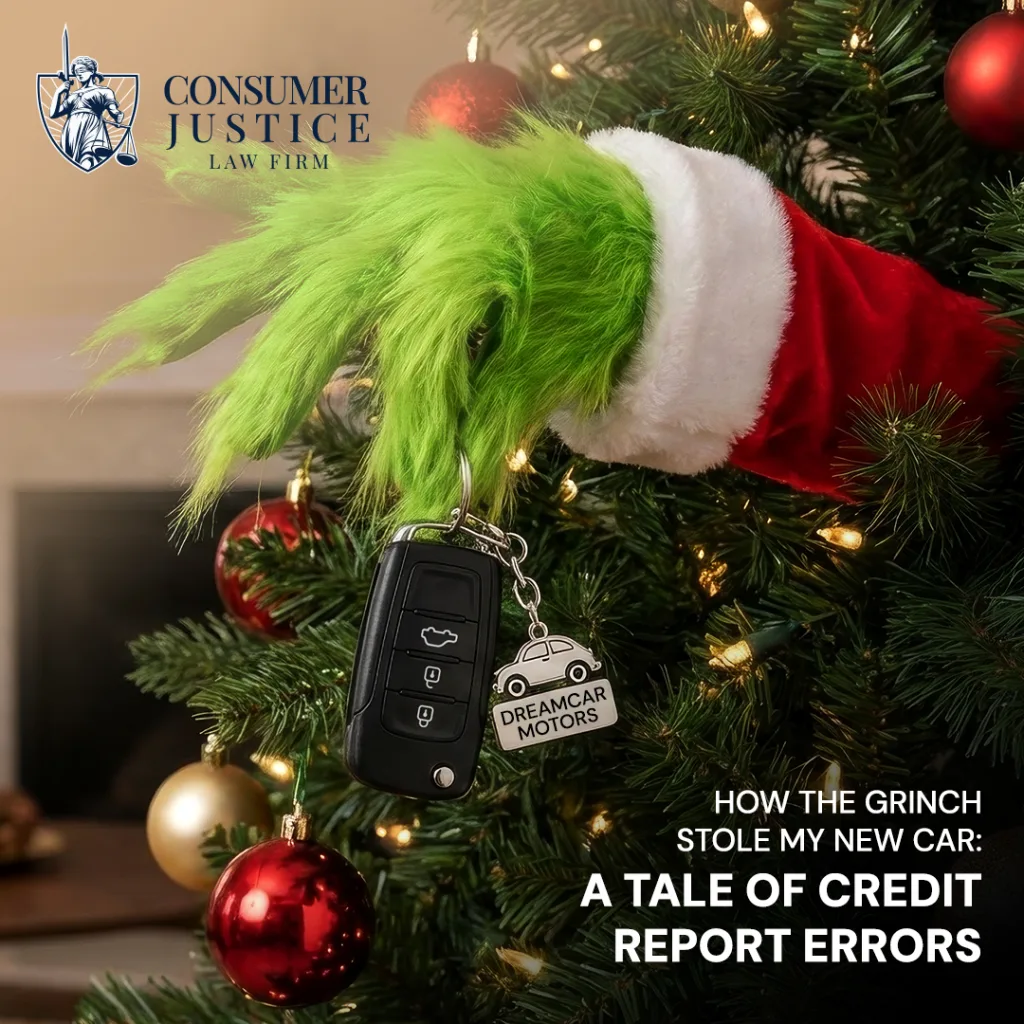
But, you may already know, perfection rarely makes it past the credit bureaus unscathed – especially when a credit report error lurks in the shadows. As Micaheal soon learned, a credit report marked with tufts of green grinchy fur, started with one credit report error, then grew into more.
Take an indepth dive into fighting and fixing credit report errors, or settle in to learn how Michael’s tale resolves. If you’ve ever opened your credit report and spotted odd markings, unexpected blemishes, or a suspicious credit report error that seemed to appear out of nowhere, you may find that Michael’s story feels all too familiar.
Quick Links
At The Dealership: The First Hint of Trouble
Michael strutted into the dealership full of peppermint optimism. His Credit Karma score two weeks earlier had flashed green and robust. He had a steady credit history, stable income, and the type of payment record that would make anyone nod in respect.
Michael felt confident as the Salesman guided him to a desk decorated with tinsel, and began the formal process of running a credit check. The Salesman offered a cookie then clicked a few keys. In no time at all, Michael expected a stamp of approval and the keys to a car.
But the Salesman turned around. Then he paused. Then he frowned. “Um… Michael,” he said, “your credit score’s gone down.”
Michael felt a drop in his stomach that mirrored his score.
“Two hundred points, after your last car purchase,” the Salesman continued gently.
Michael straightened in his chair. “Wait – what? I didn’t buy a car yet. That’s why I’m here today. How could my credit score drop 200 points after buying a car?”
The Salesman turned back, staring at the screen. Something was very wrong. Michael peered over the Salesman’s shoulder, when what to his stressed out eyes did appear?
- Accounts he had never opened
- Addresses where he never lived
- Balances for accounts he didn’t recognize
- A car purchase for a car he didn’t drive
Each line was another credit report error. One credit report error became five. Five became ten.
“Ohio?” Michael whispered. “I’ve never even visited the state.”
The Salesman took a nibble of a sugar cookie elf and nodded with sympathetic resignation. “Sir… this looks like a mixed file credit report error.”
The Mixed-File Menace
A mixed credit report is among the most disruptive forms of credit report errors. It occurs when the credit data of two different consumers, often with similar names – becomes entangled in the systems of Experian, Equifax, or TransUnion.
Michael’s otherwise spotless financial life had been stitched together with that of one Michael Lee When – a man whose credit habits read like a subplot too grim for publication. Late payments, charged-off accounts, and debts that did not belong to Micheal at all, every one of them a credit report error quietly sabotaging his holiday car-purchase plans.
This type of credit report error is not identity theft, though it can feel just as invasive. It is a bureaucratic mishap, and its consequences are very real, especially when a family’s Christmas car hangs in the balance.
A Lesson by the Fire: How to Fix Errors on a Credit Report
When the credit grinch strikes, the practical questions come quickly. How do I dispute an error on my credit report? More urgently, how to fix them for good when a credit report error threatens to upend your finances.
The first step is pulling all three reports using your annual credit report (from annualcreditreport.com), the only federally authorized free source. This is often where consumers discover just how widespread a credit report error may be.
Then, be sure to review every account, balance, and address carefully. Anything unfamiliar may signal a credit report error requiring immediate attention.
Next comes the dispute process. Knowing how to dispute credit report errors in the USA, means consumers should file disputes directly with Experian, Equifax, and TransUnion.
Each bureau is required to investigate a credit report error within thirty days under the Fair Credit Reporting Act.
Disputes can be filed online or by mail, but written disputes, complete with documentation – through certified mail – creates the strongest paper trail when correcting a serious credit report error, particularly a mixed credit file.
For official guidance straight from regulators, the Consumer Financial Protection Bureau explains the process clearly here.
Which Credit Bureau Is Most Important When Buying a Car?
Michael found himself asking this very question on his walk home through the snow. The answer, unfortunately, is whichever bureau your lender chooses to pull. While consumers often track their scores through services like Credit Karma, most auto lenders rely on FICO scores, not educational scores, when evaluating a car loan application.
Which FICO score is used, and which credit bureau supplies the data – varies by lender. Some auto lenders rely primarily on Experian. Others favor Equifax or TransUnion. In many cases, lenders use industry-specific FICO Auto Scores derived from one bureau’s report, making accuracy at each bureau critically important.
Because of this, even a single unresolved credit report error can derail an otherwise solid application. Michael’s situation was particularly unlucky, his credit report error appeared across multiple bureaus, compounding the damage and leaving lenders with a distorted picture of his true creditworthiness.
What’s a Good Credit Score for Buying a Car?
A credit score of 720 or higher typically qualifies for the best auto loan rates. Scores between 660 and 719 can still secure competitive terms. Between 600 and 659, financing becomes more expensive. Below 600, approval often comes with interest rates that feel distinctly unseasonal.
Michael’s score had once been comfortably above 700. After the credit report error, it sank into the mid-500s. The dealership offered sympathy, coffee, and very little else.
Why Did My Credit Score Drop 100 Points After Buying a Car?
Under normal circumstances, a sudden drop might follow a new loan or hard inquiries. But Michael hadn’t bought a car at all. His score fell entirely because of a credit report error linking him to someone else’s debts.
This is one of the clearest examples of how a credit report error can distort reality, and punish consumers for mistakes they never made.
Does Buying a Car Hurt Your Credit?
Buying a car can cause a small, temporary dip in credit scores. With consistent on-time payments, most consumers recover quickly. A credit report error, however, does not fade on its own. It lingers. It worsens. And it often spreads if left unchallenged.
Fixing the Errors: Michael’s Car-Buying Prospects Grew 3 Sizes That Day
Determined not to let a credit report error steal his holiday, Michael disputed every incorrect account with methodical precision. He circled each credit report error, attached documentation, and sent disputes to every bureau involved.
TransUnion corrected its file promptly. Experian followed slowly thereafter. Equifax, ever the stalwart gatekeeper, required escalation and help from Consumer Justice Law Firm, but eventually corrected the credit report error as well (and paid Michael compensation).
With each correction, Michael’s credit score grew and his stress level dropped. Knowing he’d miss out on the Christams surprise, he slipped an IOU under the tree instead. But he did so with peace in his heart, knowing no credit report error would get him denied…ever again.
After the New Year, the dealership welcomed Michael back without hesitation. And the What family discovered a gleaming new car waiting in the driveway one day, bow and all (and paid for in part by the compensation Michael received for the harm he had suffered).
When Credit Report Errors Need Justice
And so, MIchael’s holiday tale comes to a close – a reminder that even the best-laid plans can be undone by grinchy corporate carelessness and toxic credit report errors.
What began as a major gift for his family soon became a lesson in vigilance, patience, and persistence. MIchael learned what many other consumers also learn the hard way- credit report errors are not rare. But they are correctable!
If your own credit report ever starts showing unfamiliar accounts, unexplained addresses, or any other credit report error that doesn’t belong to you, Consumer Justice Law Firm is here to help.
We assist consumers in correcting inaccurate credit reporting, disputing mixed files, and holding the bureaus accountable.
May your credit reports remain accurate, your credit files untangled, and your holidays free from financial mischief, no matter how determined those consumer reporting agencies may be.
FREE Consultations! You pay $0 upfront or out of pocket. The companies we sue pay our legal bills. No Justice, No Fee.TM