
Quick Answer
Yes. Paid debts are not immediately removed from your credit report. When a debt is paid, the balance may be updated to $0, but the account’s payment history can remain for the applicable reporting period.
When Paid Debts Can Legally Remain on Credit Reports
The reporting period for information on your credit report differs for negative and positive information. Negative information is generally reportable for up to 7 years, while positive closed accounts may remain on a credit report for up to 10 years or longer, depending on the credit bureau’s policies.
When a Paid Debt May Be Reported Inaccurately
A paid debt may be reported inaccurately if a credit report continues to show a balance owed, incorrectly lists the account as delinquent or unpaid, reports inaccurate payment history, or includes information that belongs to someone else. Credit reporting agencies and furnishers must use reasonable procedures to ensure the information they report is accurate.
Do Paid Debts Affect Your Credit Score?
Yes. Paid debts can affect your credit score based on the scoring model, but whether the impact is positive or negative depends on the history and status of the account at the time it was paid.
Paid Accounts in Good Standing
Positive paid accounts may continue helping your credit history. For example, an account showing on-time payments for the duration can help your credit score.
Paid Collection Accounts
Paid collection accounts generally remain on a credit report for up to 7 years from the date of the delinquency that led to the collection account, and may be factored into your credit score for the duration.
Paying the collection account does not restart or extend the reporting period. Instead, payment typically changes the account status from unpaid to paid, settled, or paid collection.
Example:
- Missed payments began: March 2020
- Account sent to collections: October 2020
- Collection account paid: January 2024
The collection account would generally be eligible to be removed around March 2027, not January 2031.
Paid Charge-Offs
Paying a charge-off does not automatically remove it from your credit report. If accurately reported, a paid charge-off may remain for up to seven years from the delinquency that led to the charge-off.
Why the Impact Varies by Credit Scoring Model
Paying a debt may affect your credit score differently depending on the credit scoring model used, as models weigh account history, payment behavior, and collections differently.
What Types of Paid Debts May Still Appear on a Credit Report?
Paid debts that may still appear include cards, loans, collections, and charge-offs.
Credit Cards
Paid or closed credit cards may remain.
Auto Loans
Paid auto loans may remain after closing.
Mortgages
Paid mortgages may remain as closed accounts.
Collection Accounts
Paid collections may remain until reporting expires.
Charged-Off Accounts
Paid charge-offs may remain despite payment.
How Long Can Paid Debts Stay on Your Credit Report?
How long a paid account remains depends on the information reported. Negative information generally may remain for up to seven years.
Positive Account History
Positive history may remain after closing.
Paid Late Payments
Accurate late payments can generally remain seven years.
Paid Collection Accounts
Paying collection accounts won’t automatically remove the history.
Paid Charge-Offs
Accurate charge-offs may remain during the reporting period.
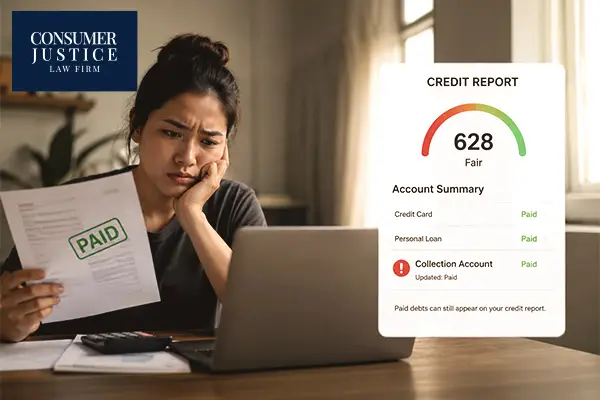
Why Does My Credit Report Still Show a Paid Debt?
Your credit report may show paid debt accounts when the remaining history is accurate.
Normal Credit Reporting Timeframes
Paid accounts may remain while legally reportable.
Update Delays
Account and payment updates may not appear immediately.
Account Status Errors
Errors may show paid accounts as unpaid.
Duplicate Reporting Issues
Occurs when accounts or debts appear multiple times.
What Should a Paid Debt Look Like on a Credit Report?
A paid debt should show accurate balance, status, and payment history.
Paid in Full Status
A fully paid debt should show as paid.
Settled Account Status
A settled account may show a reduced payoff.
Closed Account Reporting
Paid accounts may remain as closed accounts.
Zero Balance Reporting
A fully paid debt should generally show zero balance.
What If a Paid Debt Is Reported Incorrectly?
If a paid debt is reported incorrectly, you can dispute the error.
Showing an Incorrect Balance
A remaining balance may be wrong after full payment.
Reporting the Wrong Payment Status
A paid account should reflect its updated payment status.
Reporting a Debt as Unpaid After Payment
Proof of payment can show an error.
Duplicate Debt Reporting
Duplicate reporting may overstate your obligations.
How Do You Dispute an Incorrectly Reported Paid Debt?
You can dispute inaccurate paid-debt information with the credit bureau and the reporting company.
Review Your Credit Reports
Identify incorrect balances, statuses, dates, or details.
Gather Proof of Payment
Collect receipts, statements, settlement letters, or records.
Submit a Dispute to the Credit Bureau
Explain the error, provide supporting documents, and consider certified mail for disputes.
Contact the Information Furnisher
Reach out to the bank, lender, or company that reported the information.
Monitor the Investigation Results
Investigations generally take 30 days; some take 45.
Can Credit Report Errors Involving Paid Debts Hurt You?
Yes. Credit report errors involving paid debts can affect credit and other decisions.
Lower Credit Scores
Incorrect balances or statuses may hurt your score.
Loan and Credit Denials
Inaccurate negative information may contribute to denials.
Higher Interest Rates
Errors may contribute to less favorable terms.
Housing and Employment Consequences
Reporting errors may result in a denied rental application or affect a job opportunity.
Do You Have Rights Under the Fair Credit Reporting Act (FCRA)?
Yes. The FCRA gives you rights involving credit accuracy, disputes, and investigations.
The Right to Accurate Reporting
Credit bureaus must use reasonable procedures for maximum possible accuracy.
The Right to Dispute Inaccurate Information
Disputing inaccurate credit report information is free.
The Right to a Reasonable Investigation
Qualifying disputes trigger investigation duties for credit bureaus and, when applicable, furnishers.
When Should You Speak With a Consumer Protection Attorney?
You should consider a consumer protection attorney when inaccurate paid-debt reporting remains unresolved or causes harm.
A Paid Debt Is Still Reported as Owed
Legal guidance may help if a paid debt is still listed as outstanding.
The Error Remains After a Dispute
Continued inaccurate reporting may raise FCRA concerns.
You Suffered Financial or Other Harm
An attorney can assess whether losses support a claim.
FAQs About Paid Debts on Credit Reports
Can paid debts stay on your credit report?
Yes, accurate paid debts can remain within reporting periods.
How long does a paid debt remain on a credit report?
Typically, up to seven years.
Can a paid collection account still appear on my credit report?
Yes, until its reporting period expires.
Why does my credit report show a debt I already paid?
Paid accounts may remain even after the debt is resolved.
Does paying off a debt remove it from my credit report?
No, not necessarily. The balance may update to $0, but the history can remain.
Can a paid debt still hurt my credit score?
Yes, depending on its history and scoring model.
What should I do if a paid debt still shows a balance?
Dispute it and provide evidence.
How long does it take for a paid debt to update on a credit report?
Timing varies from several days to a few months.
Can I dispute a paid debt that is reported incorrectly?
Yes, incorrect paid-debt information can be disputed.
Can I sue if a paid debt continues to be reported inaccurately?
Potentially, if the reporting violates the FCRA.