
Quick Takeaway
ResidentVerify is a tenant screening service used by landlords and property managers to evaluate rental applications. If a ResidentVerify report contains inaccurate information, it can negatively affect your ability to rent a home. Federal law gives renters the right to obtain a copy of the report, dispute inaccurate information, request a reinvestigation, and pursue legal remedies when reporting errors cause harm. If a ResidentVerify error leads to a rental denial, increased deposit, or other harm, speak with a tenant screening report error lawyer for personalized guidance.
What Is Resident Verify?
ResidentVerify is a tenant screening tool used to collect and evaluate information about a rental applicant’s identity, income, rental history, and other details during the rental screening process. ResidentVerify is often mentioned alongside Entrata, the larger property-management platform used by landlords and property managers. A ResidentVerify report may influence whether someone receives rental approval, faces additional conditions, or experiences a rental denial.
What is Resident Verify by Entrata?
ResidentVerify is a tenant screening service offered through Entrata’s property-management platform. Additionally, ResidentVerify by Entrata helps landlords and property managers evaluate applicants and apply screening criteria during the leasing process. Entrata markets the service as an integrated screening system that can confirm identity, verify income, assess risk, and produce screening results.
You may also see the names Entrata ResidentVerify or ResidentVerify by Entrata. Whatever label appears on the paperwork, the practical issue is the same: information in a ResidentVerify report may influence whether you get approved for rental housing.
Entrata describes ResidentVerify as offering “hassle-free” resident screening. But hassle-free for whom - the landlord, the property manager, or the person trying to find somewhere to live?
What ResidentVerify Does
A ResidentVerify background check may examine identity information, income documents, credit data, rental history, criminal records, eviction records, and other public-record information, depending on the screening package and criteria selected by the housing provider.
In plain English, ResidentVerify tenant screening turns a pile of data into information a landlord may use to judge a rental application.
How Landlords and Property Managers Use ResidentVerify Reports
A property manager may use ResidentVerify rental screening to approve an applicant, approve the applicant with conditions, or deny the housing application.
Conditions may include: a larger deposit, a guarantor, or other requirements. Entrata states that housing providers can customize screening parameters and apply them through the system.
The landlord makes the housing decision, but the Resident Verify report may supply the information behind that Landlord’s decision. When the data is wrong, the landlord’s decision may be wrong too - just faster and with better software.
Information Commonly Included in ResidentVerify Reports
The contents of a ResidentVerify report may vary, but a tenant screening report can commonly include:
- Identity verification and personal identifiers (name, social security number, date of birth, etc.)
- Credit report information
- Rental history and payment information
- Criminal history or criminal records
- Eviction records and civil court records
- Income or employment verification
- Public-record information
- A screening recommendation, score, or result
A tenant background check is not automatically inaccurate merely because it contains negative information. The concern arises when the report contains errors, which includes any information that is inaccurate, incomplete, false, outdated, incomplete, unreportable, duplicate, the result of identity theft, or someone else’s.
How a ResidentVerify Report Can Affect Your Housing Application
A ResidentVerify report can affect your housing application by factoring heavily into whether you are approved or denied, how much security deposit you’re asked to pay, and other terms and conditions of your lease (such as needing a co-signer).
Can ResidentVerify cause a rental application to be denied?
Yes. A landlord or property manager may rely on a Resident Verify report when deciding whether to approve an apartment application, require additional conditions, or issue a rental rejection.
This means an inaccurate ResidentVerify report may contribute to:
- A rental denial or housing denial
- A higher security deposit
- A required guarantor or co-signer
- Delayed rental approval
- Lost application fees
- Higher moving or temporary-housing costs
- The loss of a particular apartment rental or other housing opportunities
A reporting error is not “just a mistake” when it leaves someone racing to find housing before a lease expires. That is not an inconvenience. That is a countdown clock with moving boxes.
ResidentVerify Errors and Your Rights at a Glance
| Question | Short Answer |
|---|---|
| What is ResidentVerify? | A tenant screening service used by landlords and property managers during the rental application process. |
| Can a ResidentVerify error affect my housing application? | Yes. Inaccurate information can contribute to apartment denials, delays, higher deposits, or other adverse housing decisions. |
| What errors appear on ResidentVerify reports? | False criminal records, inaccurate eviction records, mixed files, identity theft information, outdated records, and incorrect personal information. |
| Does the Fair Credit Reporting Act apply to ResidentVerify? | Yes. Tenant screening companies that provide consumer reports are typically subject to FCRA requirements. |
| Can I dispute a ResidentVerify report? | Yes. Consumers generally have the right to dispute inaccurate or incomplete information. |
| How long does a ResidentVerify investigation take? | Investigations are typically completed within 30 days, although limited extensions may apply. |
| What should I do after a rental denial over inaccurate information? | Obtain the report, identify inaccuracies, preserve documents, submit a written dispute, and consider speaking with an FCRA attorney. |
| Can I sue over a ResidentVerify error? | Potentially. Legal claims depend on the facts, the nature of the reporting error, the handling of any dispute, and the resulting harm. |
Common ResidentVerify Report Problems Renters Experience
Why is my Resident Verify report inaccurate? There is no single answer. But one thing is clear: ResidentVerify errors can come from several points in the screening process, and even one bad match can create serious problems for a renter.
Tenant screening errors can result from poor matching procedures, incomplete court data, outdated databases, data-entry problems, or failures to update records after a case changes.
Common ResidentVerify errors include:
- A ResidentVerify report wrong criminal record belonging to another person
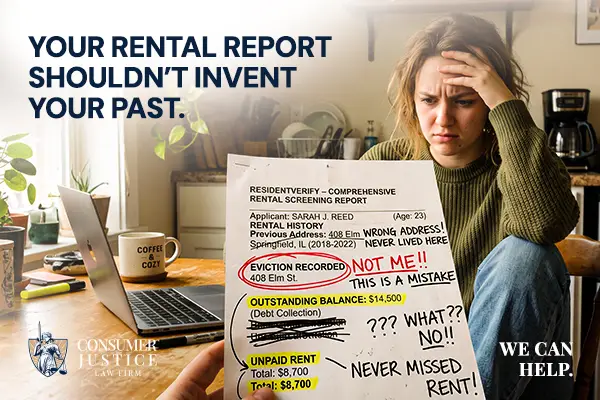
- A Resident Verify false eviction record
- A ResidentVerify mixed file error combining two consumers’ information
- A false criminal record matched by name rather than reliable identifiers
- A wrong eviction record with the wrong outcome or person
- Criminal history errors that omit a dismissal or other disposition
- Duplicate or outdated records
- Rental history attributed to the wrong applicant
- Identity theft errors
- Incorrect addresses, birth dates, or Social Security number fragments
- Other report inaccuracies or background check mistakes
Mixed files are especially dangerous for people with common names. “Same name” does not mean “same human.” Michael Johnson should not lose an apartment because a database found a different Michael Johnson and decided detective work was optional.
How accurate is Resident Verify? Ask the renters sharing their ResidentVerify complaints on Reddit, and the reviews may be less than glowing. Online complaints do not prove that every report is inaccurate, but they do show why accuracy matters when someone’s housing is on the line. No screening company gets a legal participation trophy merely because most reports may be correct. The report used against you must be handled in compliance with the law.
Your Rights Under the Fair Credit Reporting Act (FCRA)
Does the FCRA apply to Resident Verify background checks? Yes - When ResidentVerify provides consumer reports used to determine housing eligibility, the Fair Credit Reporting Act generally applies.
Tenant screening services are among the consumer reporting agencies covered by the FCRA.
Your Fair Credit Reporting Act rights and broader housing rights involving consumer reporting may include:
- The right to receive an adverse action notice when a consumer report contributes to a housing denial or other unfavorable decision
- The right to obtain the screening company’s name and contact information
- The right to request a free copy of report after an adverse action
- The right to dispute an inaccurate background check or incomplete information and have disputed information reviewed
- The right to have disputed information reasonably investigated
- The right to correct inaccurate information or have inaccurate or unverifiable information removed
- The right to seek legal remedies when an FCRA violation causes harm
A landlord’s adverse action notice should identify the consumer reporting agency and explain the applicant’s right to dispute the report and obtain a free copy.
The FCRA also requires consumer reporting agencies to follow reasonable procedures for accuracy. “We copied what the database said” is not necessarily the legal mic drop a company may think it is.
How to Dispute Errors on a ResidentVerify Report
How do I dispute a ResidentVerify report? The same way you dispute a tenant screening report by any other rental screening service. Start with evidence and a paper trail - not seventeen angry voicemails, however spiritually justified they may feel.
- Request the complete ResidentVerify report. Ask for the file or report used in connection with the rental application.
- Identify each error precisely. State what is wrong, why it is wrong, and what the correct information should be.
- Gather supporting records. Useful documents may include identification, court records, dismissal orders, payment records, correspondence, police reports, or identity-theft documents.
- Submit a written ResidentVerify dispute. Include copies, not originals, and retain proof of delivery. We recommend sending disputes through certified mail because doing so helps retain proof of delivery.
- Dispute with the source when appropriate. You may also dispute with the court-data vendor, creditor, landlord, or other furnisher that supplied incorrect information.
- Save everything. Keep the report, denial notice, application, dispute, attachments, delivery confirmation, investigation results, and communications.
Under the FCRA, a consumer reporting agency generally must conduct a reasonable reinvestigation, commonly within 30 days, although limited circumstances can extend the period.
A proper report investigation should evaluate the disputed information. It should not be a ceremonial button press followed by “verified” in a tasteful font.
What to Do If a ResidentVerify Error Costs You Housing
Denied housing because of Resident Verify? Contact our firm.
Before records disappear into inboxes, portals, and the mysterious realm where leasing-office voicemails go to retire, preserve:
- The ResidentVerify report
- The adverse action or housing denial notice
- The rental application and landlord screening criteria
- Proof of application fees, deposits, hotel costs, storage, moving expenses, or increased rent
- Your ResidentVerify dispute and supporting documents
- The reinvestigation results
- Emails, texts, and notes from calls with the landlord, property manager, or screening company
Then contact Consumer Justice Law Firm for a free case review. We evaluate whether an inaccurate ResidentVerify report, inadequate reinvestigation, or other reporting conduct may support legal action.
Can I take legal action over a ResidentVerify reporting error?
Yes. Depending on the facts, an applicant may be able to pursue a ResidentVerify lawsuit under the FCRA. Available claims and compensation for background check errors depend on the violation, the company’s conduct, and the harm caused.
Possible damages may include actual financial losses, emotional-distress damages, statutory damages for certain willful violations, punitive damages, attorney’s fees, and costs.
Signs You May Have a Claim Against ResidentVerify
An incorrect background check may signal a Resident Verify FCRA issue, giving rise to a legal claim. Your situation deserves closer review when:
- ResidentVerify reported another person’s criminal or eviction records
- The company relied on weak name-only matching or ignored conflicting identifiers
- Clearly outdated or facially inconsistent information appeared in the report
- You filed an FCRA dispute, but no meaningful reinvestigation occurred
- Disputed information remained despite documents showing it was wrong
- The company failed to correct inaccurate information
- The landlord failed to provide a required adverse action notice
- You could not obtain a free copy of report after the adverse action
- Reporting errors continued causing rental denials or other harm
Can I sue ResidentVerify?
Yes, but whether you can sue ResidentVerify depends on what was reported, how the company handled the information and dispute, whether the law was violated, and what damage followed. A ResidentVerify FCRA lawsuit requires facts (evidence), not just frustration.
Speak With a Consumer Rights Attorney About ResidentVerify Errors
Our firm represents consumers harmed by tenant screening report errors, background check errors, mixed files, false criminal records, identity theft errors, reporting errors, and inadequate dispute investigations.
A consumer protection attorney or FCRA attorney at our firm can review the inaccurate ResidentVerify report, the ResidentVerify dispute, the housing provider’s decision, and the damages you experienced. We can then explain your consumer rights and whether a ResidentVerify lawsuit or other legal action may be appropriate.
Contact Consumer Justice Law Firm for a free case review if ResidentVerify background check errors affected your rental housing.
Our firm can help determine whether you may have a claim and what steps make sense next.
Frequently Asked Questions
ResidentVerify is used for tenant screening during the rental application process. A landlord or property manager may use it to review identity, income, credit, rental history, criminal records, eviction records, and other risk information before making a rental approval or rental rejection decision.
Request a copy of your report directly from ResidentVerify using the contact information in your adverse action notice. When a report contributed to a housing denial or other adverse action, you generally have the right to a free copy of the report if you request it within 60 days.
A ResidentVerify dispute will generally be investigated within 30 days, though the FCRA allows limited extensions in some circumstances. Keep proof of when the dispute was received and review the results carefully. “Completed” and “correct” are not synonyms.
Yes, it can and does happen. However, it is not lawful to do so. A mixed file error, weak matching process, identity theft, or incorrect public-record match may place another person’s criminal records, eviction records, or account information in your ResidentVerify report. That information should be disputed promptly.
Obtain the ResidentVerify report, identify every error, submit a written dispute with supporting documents (we suggest doing this via certified mail), preserve the adverse action notice and proof of damages, and contact our firm. Do not rely on a leasing agent’s summary of the report. Get the actual report - the data version of “show me the receipts.”
Not necessarily. You can submit a ResidentVerify dispute yourself. However, speaking with a lawyer may be important when the error caused a housing denial or increased deposit or other harm, ResidentVerify ignored or mishandled your dispute or failed to correct inaccurate information, or you are considering whether to sue Resident Verify. A free case review can help you understand whether the facts suggest an FCRA violation and what legal action may be available.
If ResidentVerify errors blocked your application, led to higher deposits, or caused other harm, get a FREE consultation. You pay $0 out of pocket. We only get paid when we win. No Justice, No Fee™