
Key Takeaway
Background checks are not infallible. Errors such as mixed files, mistaken identity, outdated information, false criminal records, and expunged or sealed records that continue to appear can cost consumers jobs, housing, professional opportunities, and income. If an inaccurate background check harms you, the Fair Credit Reporting Act (FCRA) gives you the right to obtain the report, dispute inaccuracies, seek corrections, and, in some cases, pursue compensation through legal action.
Incorrect Background Checks: What They Are, Why They Happen, and How to Fix Them
For most people, the so-called American dream is refreshingly simple. Work hard. Earn a decent living. Maybe build a family. Find a home. Own a reliable car. And someday, after years of effort - retire somewhere warm, with sunshine, palm trees, and the occasional questionable life choice involving flip-flops or short shorts.
You’re busy planning that future. What you’re not planning for is waking up one day to find your progress quietly destroyed by an incorrect background check. No warning. No explanation. Just a polite rejection email, a job offer that suddenly disappears, or a hiring process that grinds to a halt without telling you why. One moment you’re moving forward. The next, you’re stuck trying to figure out how an incorrect background check became the gatekeeper of your livelihood.
This article explains what an incorrect background check is, why background check errors happen, how they can affect your life, how to fight mistakes by disputing an incorrect background check properly, and when legal help for background check errors is a strong option.
Quick Facts
1. Background checks can contain errors. 2. Common mistakes include mixed files and false criminal records. 3. You have the right to obtain a copy of your report. 4. You can dispute inaccurate information. 5. The FCRA requires reasonable procedures to assure accuracy. 6. You may be able to get compensation if the errors caused harm.
Can a Background Check Be Wrong?
Yes. In the same way that a printer can jam five minutes before an important deadline or your GPS can confidently tell you to turn left into a lake, your background check can peddle untruths.
A background check is not a single document pulled from a flawless, all-knowing national database. It is a report assembled by a consumer reporting agency like a tenant screening company or an employment reporting agency using court records, public data, vendor databases, and automated systems that are only as accurate as the information fed into them. When those systems fail- and they frequently do - the result is an incorrect background check.
A background check with incorrect information can be caused by various things. Criminal background check errors can show up when court dispositions aren’t updated or criminal records are misattributed. Employment background check errors can occur when employment data is outdated or data is entered incorrectly due to typos. Entire files may be merged because two people happen to share a similar name or date of birth, a situation known as a mixed file. Regardless of the cause, the impact is always the same: a report that does not accurately reflect who you are.
Despite legal obligations under the Fair Credit Reporting Act (FCRA), background check errors remain common. Even well-known companies are not immune. Consumers routinely report:
- Checkr errors
- HireRight errors
- First Advantage background check mistakes
- Accurate background check errors
- Sterling background check complaints
- Asurint background check problems.
A recognizable brand name may inspire confidence, but it does not guarantee accuracy, and it certainly does not excuse an incorrect background check.
Knowing that a background check can be wrong naturally leads to the next question: what does an incorrect background check actually look like in practice? Let’s explore this question below.
What Is an Incorrect Background Check? (Definition & Examples)
At first glance, the question “What is an incorrect background check?” may sound a little silly. After all, how hard can it be to get someone’s background right? You either did something or you didn’t…right?
Not exactly.
An incorrect background check is one that contains information that is incomplete, outdated, misleading, unreportable, someone else’s, or simply wrong. These reports are often treated as definitive, even though they are built from databases, records, and automated systems that do not always communicate particularly well with one another. When that breakdown happens, the result is a report that does not accurately reflect the person it is supposed to describe.
Below are some of the most common, and surprisingly relatable ways a background check becomes “incorrect.”
Mixed file background checks (a.k.a. identity chaos)
A mixed file background check occurs when your information gets blended with someone else’s. This often happens because you share a name, a similar date of birth, or other identifying details. Maybe your parents thought naming you after Aunt Sally was a charming tribute. Years later, you discover that Sally’s legal adventures are now appearing on your background check. Family resemblance should not extend this far.
Mistaken identity background checks
Closely related to mixed files, a mistaken identity background check happens when a reporting agency connects you to records that belong to someone else entirely. Different person. Different life. Same headache. Suddenly, you are explaining to a potential employer that you are not, in fact, the individual who did whatever the report confidently suggests.
Outdated background check information
This one is especially frustrating. You did everything right. You waited the required time. You complied with the law. And yet, outdated background check information still appears as though no one bothered to update the file. A common example is a dismissed charge from greater than seven years ago. Think of this type of error as your past refusing to move out, even after the lease expired.
Expunged record still showing
An expunged record still showing is one of the clearest examples of an incorrect background check. Expungement is meant to remove a record from public view. When it still appears, it is not just inconvenient and bad reporting - it is in direct violation of a court order.
Sealed record still showing
A sealed record still showing presents a similar problem. Sealing a record is supposed to limit access. When that information continues to appear, it is like locking a glass filing cabinet and then placing it in the front window with the lights on.
False criminal records
A false criminal record on background check can arise from data errors, incorrect court reporting, or system assumptions that should never have been made. Few things are more unsettling than being linked to criminal activity that never happened.
False or inaccurate employment records
A false employment record may list employers you never worked for, incorrect dates, or reasons for separation that are simply untrue. Explaining your work history is challenging enough without also correcting a report that seems to have taken creative liberties.
Each of these situations leads to the same outcome: an incorrect background check that causes real-world consequences, even though the underlying information is wrong.
Common Background Check Errors and What To Do
| Error Type | What It Means | Potential Consequences | Recommended Action |
|---|---|---|---|
| Mixed File | Your report contains information belonging to someone else with a similar name or identifying information. | Job denial, housing denial, insurance denial, reputational harm. | Obtain the report, document the error, and dispute immediately. |
| Mistaken Identity | A reporting agency incorrectly associates another person’s records with you. | Lost employment opportunities and delayed hiring. | Provide identification records and request a reinvestigation. |
| Outdated Information | Old information remains on the report after it should have been updated or removed. | Employment or housing decisions based on stale data. | Dispute the inaccurate information and demand correction. |
| Expunged Record Still Showing | A record that should have been removed continues to appear. | Job loss, licensing issues, rental denials. | Submit proof of expungement and dispute the reporting. |
| Sealed Record Still Showing | A sealed court record remains visible in a screening report. | Adverse employment or housing decisions. | Request correction and preserve documentation. |
| False Criminal Record | Criminal information that does not belong to you appears on the report. | Rescinded job offers, lost opportunities, emotional distress. | Act quickly to dispute and consider consulting an attorney. |
| Inaccurate Employment History | Incorrect employers, dates, or job separation information appears. | Hiring delays or denial of employment. | Gather employment records and challenge the inaccuracies. |
What Happens If a Background Check Contains Errors?
An incorrect background check is not a small inconvenience. It is not a typo you shrug off or a small clerical hiccup that fixes itself overnight.
An incorrect background check has an unfortunate habit of showing up at the most inconvenient moment possible - right after you give notice at your old job, right before your start date, or right when you finally feel like things are going your way. Instead of celebrating progress, you find yourself explaining that you are, in fact, not secretly running an underground criminal empire, despite what the report seems to suggest.
An incorrect background check can result in very real and very serious harm, including things like:
- Being denied a job due to background check issues that are factually wrong
- Loss of the ability to volunteer or join professional, educational, or community organizations that require background checks
- Having a job offer rescinded because of a background check decision - after you already accepted and planned your next steps
- Being denied the opportunity to foster, adopt, or care for children where background checks are required for approval
- Severe emotional distress - background check consequences tied to stress, embarrassment, sleeplessness, anxiety, and uncertainty
- A delayed job because of background check problems that stall your career and income
- A lost job due to background check errors, including termination after employment has already begun
- Denied housing opportunities when landlords rely on inaccurate background check information
- Financial losses that support damages for inaccurate background check claims and compensation for background check mistakes
Many of these harms stem from the same recurring issues: a false criminal record, an incorrect criminal history on background check, outdated background check information, an expunged record still showing, a sealed record still showing, a mixed file background check, or a mistaken identity background check.
When any of these appear in an incorrect background check, the consumer often pays the price - sometimes in lost income, sometimes in lost opportunities, and sometimes in lost sleep while wondering how someone else’s paperwork became their problem.
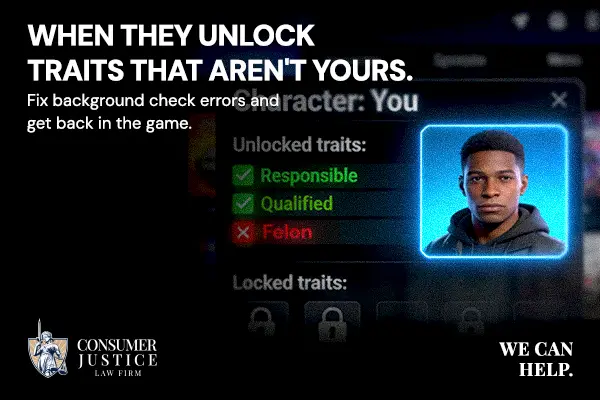
How to Fix an Incorrect Background Check
Fighting an incorrect background check requires action, organization, and timing. While each situation is unique, there are several foundational steps that apply to nearly every case. This section breaks those steps down clearly and practically.
1. Get a copy of the background check
You cannot fight an incorrect background check if you have not seen it. Under the Fair Credit Reporting Act (FCRA), you have the right to request a copy of the background check used against you. If you were denied employment due to background check results, the employer is required to provide information about the consumer reporting agency that prepared the report.
Obtaining the report allows you to identify background check errors, whether they involve a false criminal record on background check, a false employment record, or other background check mistake issues that should not be there.
2. Keep everything
Documentation matters. If an incorrect background check has affected your employment, you should preserve every relevant record. This includes job postings, offer letters, rejection notices, emails, background check dispute confirmations, screenshots, and any correspondence with the employment reporting agency or employer.
These records can become critical evidence if the dispute escalates into a background check lawsuit or if FCRA violations are discovered later.
3. Consider a lawyer
An incorrect background check is often a legal issue. A qualified background check lawyer or FCRA lawyer, also called an attorney for background check errors, understands how to identify inaccurate reporting under the FCRA, preserve your rights, and get the errors corrected or removed.
While some consumers attempt to resolve background check errors alone, many discover that professional guidance significantly increases the likelihood of a meaningful correction - and potential recovery.
How Do You Dispute a Background Check Error?
Disputing an incorrect background check is a legal right. The law gives you the ability to challenge errors and demand accuracy. That said, how you go about disputing the report can dramatically affect how long the process takes, how stressful it becomes, and whether it actually gets fixed, or just politely ignored.
Disputing an incorrect background check without a lawyer
The processes for disputing an incorrect background check with, and without, a lawyer are not totally unrelated processes, but there are meaningful differences to consider.
Acting without a lawyer, you’ll dispute background check errors directly with the reporting company, whether it’s employment background check errors, tenant screening errors, or insurance report errors.
- Obtain a copy of the report used to make decisions against you.
- Identify errors and clearly mark them on the report
- Gather supporting evidence
- Draft and submit a dispute letter, along with copies of the evidence
- Demand a proper reinvestigation instead of surface-level or ignored disputes.
- Track the background check correction timeline so errors don’t linger indefinitely.
- Find a lawyer if the background check companies refuse to correct errors.
Most screening companies (called consumer reporting agencies) provide online dispute portals or written submission options, which usually involve identifying background check incorrect information, uploading documents, and clicking a reassuring-looking “submit” button.
For example, individuals disputing Checkr errors are often directed to Checkr’s dispute process, which you can find here.
Reporting agencies may respond slowly, ask for the same documentation more than once, or conclude that the incorrect background check has been “verified,” without offering much explanation. For someone facing a denied job due to background check outcome, this can feel like watching an opportunity slowly drift away while your dispute sits in review.
Disputing an incorrect background check with a lawyer
Disputing an incorrect background check with legal representation tends to change the experience, and the tone, of the conversation. An employment lawyer experienced in background check disputes or a tenant screening lawyer understands the requirements imposed by the Fair Credit Reporting Act (FCRA) and knows how to enforce them effectively.
Instead of guessing which documents to submit or wondering whether your dispute was taken seriously, an attorney can:
- Obtain a copy of the report used to make decisions against you.
- Advise you on the best evidence to support your dispute and help you gather it from various sources.
- Identify violations of the Fair Credit Reporting Act (FCRA) and hold background check companies accountable.
- Demand a proper reinvestigation instead of surface-level or ignored disputes.
- Eliminate the guesswork of which documents to submit or whether your dispute was taken seriously.
- Track the background check correction timeline so errors don’t linger indefinitely.
- Take your claim to court if the background check companies refuse to correct errors.
- Relieve you of a major headache by handling the entire dispute process on your behalf.
- Get justice and real results, not delays or generic responses.
This is especially helpful when dealing with mixed file background check problems, repeat reporting errors, or stubborn criminal background check errors that refuse to disappear.
In many cases, legal involvement leads to faster corrections, clearer answers, and stronger accountability. More importantly, it protects your right to pursue damages if the reporting agency fails to act responsibly - so the burden of fixing an incorrect background check does not fall entirely on your shoulders.
Can You Sue For an Incorrect Background Check?
Yes. When an incorrect background check causes real harm and the reporting agency fails to correct it after being notified, the law provides remedies, and it expects those remedies to be taken seriously. You can sue for background check errors that hurt your employment opportunities, you can sue for tenant screening errors that block your rental prospects or cause higher deposits, you can sue for insurance report errors that impact coverage and rates, and you can sue for similar errors that bring different consequences.
Think of it this way: noticing background check errors and not disputing them is a bit like realizing your canoe is drifting straight toward the rapids and choosing to admire the scenery instead of using the paddle sitting right in front of you. The Fair Credit Reporting Act (FCRA) gives consumers that paddle. Using it is what turns a bad situation into a fixable one.
Under the Fair Credit Reporting Act (FCRA), consumers may sue for inaccurate background check reporting, failure to correct errors, or other FCRA violations. This includes situations involving a false criminal record on background check reports, an incorrect criminal history on background check, unresolved employment background check errors, or reporting agencies that decide “close enough” is an acceptable standard. It is not.
Consumers directly sue background check companies such as Checkr, HireRight, First Advantage, Sterling, or Asurint when the facts support legal action. Accountability matters, especially when errors are preventable.
A successful background check lawsuit may allow you to recover damages for inaccurate background check reporting, compensation for emotional distress, statutory damages, and attorney’s fees.
If you are wondering whether you can sue for background check errors, a free case evaluation with a knowledgeable attorney can help clarify your options before an incorrect background check costs you more than it already has.
Incorrect Background Check: Your Rights & Remedies
| If This Happens… | You May Have the Right To… |
|---|---|
| You are denied a job because of a background check | Request a copy of the report and dispute errors. |
| A job offer is rescinded | Challenge inaccurate information and seek correction. |
| Your report contains someone else’s records | Dispute the mixed file and demand reinvestigation. |
| An expunged or sealed record appears | Request removal and investigate potential FCRA violations. |
| A reporting agency fails to fix errors | Consult an attorney and evaluate potential legal claims. |
| You suffer financial or emotional harm | Explore compensation and legal remedies available under the FCRA. |
Get Corrections & Compensation with Consumer Justice Law Firm
Consumer Justice Law Firm is a dedicated consumer protection law firm that helps individuals dispute incorrect background check reports, enforce FCRA rights, and pursue justice when reporting agencies get it wrong. We understand how disruptive an incorrect background check can be, and we know how to fight back.
If you believe an incorrect background check has cost you a job, delayed your career, blocked your from a rental, caused an insurance denial, lead to worse financial terms, or caused unnecessary stress, now is the time to act.
Reach out to Consumer Justice Law Firm today and take the first step toward clearing your name and reclaiming your future.
Frequently Asked Questions
Yes. Background checks can contain inaccurate, incomplete, outdated, or misleading information, including records belonging to another person, false criminal history, or records that should no longer appear.
Request a copy of the report, identify inaccuracies, gather supporting documentation, and submit a dispute to the background check company. You may also consult an attorney if the error is not corrected.
Most consumer reporting agencies are required to investigate disputes within prescribed FCRA timeframes, though the exact timeframe depends on the circumstances.
Yes. If a background check company violates the FCRA and the inaccuracies cause harm, you may have legal remedies, including recovery of damages and attorney’s fees.
Common errors include mixed files, mistaken identity, false criminal records, outdated information, expunged records that still appear, and inaccurate employment history.
If your employment, rideshare, rental, insurance, or other opportunity was unfairly impacted by a background check error, get a FREE consultation. You pay $0 out of pocket. We only get paid when we win. No Justice, No Fee™