Key Takeaway
Credit report errors can increase the cost of buying a car even if you’re approved for financing. If your credit report shows inaccurate late payments, collections, balances, or accounts that don’t belong to you, it can lower your credit score, trigger higher interest rates, increase down payment requirements, impact your ability to secure adequate car insurance, or lead to less favorable loan terms. Reviewing your credit reports before applying for an auto loan can help you identify and dispute errors before they affect financing offers.
How Credit Report Errors Can Raise the Cost of Buying a Car
Buying a car is already expensive. Between the vehicle price, taxes, insurance, and financing, there are plenty of numbers to keep track of. The last thing you need is a credit reporting mistake quietly making the deal more expensive.
For many consumers, credit report errors auto loan problems can affect whether financing is approved, what interest rate is offered, how much money is required for a down payment, and how large the monthly payment becomes.
A lender may see an inaccurate late payment, collection account, balance, or account that does not belong to you. If that information lowers your credit score or makes your credit history look riskier than it really is, you may end up paying more for the same car.
That is why scenarios involving credit report errors causing auto loan issues deserve attention before you start signing paperwork at the dealership. And why consulting with a credit report error lawyer can help you get back on track to the rates and the car you deserve.
Ways a credit report error can increase the cost of buying a car include:
- Higher interest rates
- Larger monthly payments
- Bigger down payment requirements
- Less favorable loan terms
- Loan denial
- A requirement for a cosigner
- More expensive financing options
Can Credit Report Errors Affect an Auto Loan?
Yes. Credit report errors can affect both auto loan approval and pricing. If inaccurate information lowers your credit score or makes you appear riskier to lenders, you may receive a higher interest rate, larger down payment requirement, or less favorable loan terms. In addition, credit report errors can affect your ability to get adequate and affordable coverage through an auto insurance policy.
Why Auto Lenders Review Credit Reports
Auto lenders use credit reports to estimate the risk of lending money to a borrower. They may consider your payment history, outstanding debt, account balances, length of credit history, and other information when deciding whether to approve a loan and what terms to offer.
Credit report errors impacting auto loan decisions can therefore go beyond affecting just a simple yes or no.
Your Credit Score Can Affect the Price of Borrowing
Interest can add thousands of dollars to the total cost of an auto loan. If inaccurate information lowers your credit score, you may be placed in a higher-risk pricing tier.
A higher interest rate credit report error problem can mean paying more every month and over the life of the loan. This is one reason credit report errors causing auto loan issues can be expensive even when you still drive away with the car.
How Credit Report Errors Can Affect a Car Loan
| Credit Report Error | Possible Effect on Auto Financing |
|---|---|
| Account that does not belong to you | May lower your credit score and make you appear riskier to lenders |
| Incorrect late payment | Can reduce your score and lead to higher interest rates |
| Wrong account balance | May increase reported debt and affect loan approval or pricing |
| Incorrect collection account | Can negatively impact creditworthiness and financing terms |
| Duplicate negative account | May make financial problems appear more severe than they are |
| Outdated negative information | Can unfairly hurt your credit profile long after it should have been removed |
| Reinserted previously deleted information | May cause lenders to rely on inaccurate risk assessments |
| Identity theft account | Could result in loan denial, higher rates, or requests for additional verification |
Credit Report Mistakes That Can Affect Auto Financing
An inaccurate credit report car financing decision may result from many types of errors. Some are obvious. Others may look minor until they change the rate you are offered.
Accounts That Do Not Belong to You
Mixed-file errors can cause another person’s account to appear on your report. This may happen when consumers have similar names, addresses, dates of birth, or other identifying information. Accounts that are not yours should be taken seriously, particularly if the lender relied on them when setting the loan terms.
Incorrect Late Payments
Payment history can have a major effect on credit scoring. If an account is reported late when you actually paid on time, the error can lower your score and affect financing offers. A car loan denied due to a credit report error situation may be especially frustrating when the supposed late payment never happened.
Wrong Balances or Credit Limits
A creditor may report the wrong balance or credit limit. This can make it appear that you’re using more of your available credit than you really are. A mistake like this may affect your credit score and how a lender views your existing debt obligations.
Errors that overstate your debt obligations can make it harder to qualify for favorable loan terms and may result in a higher interest rate or monthly payment.
Duplicate, Outdated, or Reinserted Information
Collections or other negative information may appear more than once. Information may also remain after it should no longer be reported, or an item that was previously corrected may reappear. Credit report errors impacting auto loan decisions because of duplicate or outdated information can unfairly make you look riskier than the facts support.
How Errors Can Lead to Higher Monthly Payments
A reporting error does not need to cause a denial to hurt you. For many buyers, the real damage appears in the financing terms.
A Small Rate Difference Can Add Up
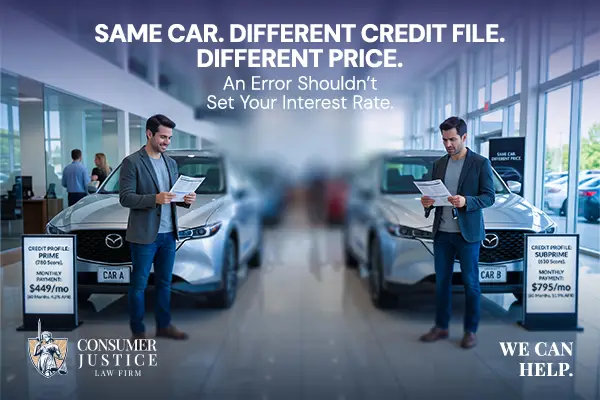
Imagine two borrowers finance the same amount for the same term. One receives a lower interest rate because the lender sees an accurate credit profile. The other receives a higher rate because inaccurate negative information appears on the report.
That is how credit report errors can affect auto loan pricing, quietly making the costs more expensive. You may never receive a letter saying, “This error cost you money.” Instead, the harm may be buried inside the rate, payment, or loan terms you were offered.
Errors Can Affect Down Payment Requirements
Some lenders may respond to perceived credit risk by requiring more money down. Auto loan problems caused by credit report errors can therefore affect both the amount you finance and the amount of cash you need upfront.
You May Be Pushed Toward Worse Financing
A buyer who expected favorable financing may suddenly be told that only a higher-cost loan is available. When a vehicle is needed for work, school, childcare, or daily life, walking away may not feel realistic. That urgency can make credit report errors during the car buying process especially costly.
What to Do Before Applying for an Auto Loan
Review Your Credit Reports Early
Check your credit reports before shopping for financing. You can pull reports from all three bureaus: Equifax, Experian, and TransUnion for free at annualcreditreport.com.
Look for unfamiliar accounts, incorrect late payments, wrong balances, duplicate collections, outdated information, and identity errors.
Credit report errors during auto loan processing are much easier to address when you have time to investigate them before a lender is waiting for an answer.
Please note: AnnualCreditReport.com is a useful place to review the information appearing on your credit reports, but the credit scores used by auto lenders may be different. Some lenders use specialized FICO Auto Scores when evaluating an application. The scoring model varies by lender, so consider asking which credit score or scoring model will be used before you apply.
Gather Documents That Show What Is Wrong
If you find an error on your credit report, collect the evidence to prove it.
Useful records may include:
- Account statements
- Payment confirmations
- Bank records
- Creditor letters
- Identity theft reports
- Prior dispute results
- Court records
- Loan payoff documents
Keep the documents organized. Future you will appreciate not having to search six email accounts for the one document that proves your point.
Compare Financing Offers Carefully
Do not focus only on the monthly payment. Compare the interest rate, loan term, amount financed, fees, down payment, and total cost. A longer term can make the monthly payment look smaller while increasing what you pay overall.
If credit report errors auto loan issues are affecting your offer, comparing the full terms may help you see the financial impact.
Disputing Errors and Protecting Your Rights
If inaccurate information appears on your credit report, you have the right to dispute it under the Fair Credit Reporting Act (FCRA). When you file an auto financing credit report dispute, be careful to clearly identify what information is wrong and why.
Be Specific in Your Dispute
- Identify the account or item you are challenging
- Explain the problem in plain language
- Include documents that support your position
- Consider disputing through certified mail (this creates a papertrail)
If the account is not yours, say that. If a payment was made on time, provide proof. If a balance is wrong, identify the correct amount and show where it comes from.
A credit report error auto loan dispute should give the reporting agency enough information to understand the actual issue. Read more about preparing a credit report dispute.
Keep a Paper Trail
We recommend keeping copies of disputes, supporting documents, responses, and proof of delivery when appropriate. This is usually best done by sending your dispute through certified mail, which also helps you preserve all of your legal rights.
If the error remains, your records may help show that the reporting agency knew of the error, what evidence you provided, and how the agency responded.
A Dispute Should Lead to a Real Review
The Fair Credit Reporting Act generally requires consumer reporting agencies to follow reasonable procedures to assure maximum possible accuracy and to conduct a reasonable reinvestigation when consumers dispute inaccurate information.
If credit report errors stemming from the auto loan process remain after you’ve submitted clear evidence, review the response carefully. Ask whether the investigation actually addressed what you disputed.
What If the Loan Was Already Denied?
You can still dispute inaccurate information after a denial. An FCRA auto loan denial may also involve adverse action rights. If a lender takes adverse action based on information in a consumer report, the consumer generally should receive information identifying the reporting agency and explaining certain rights. This notice can help you determine where the lender obtained the information.
Credit report error impacting an auto loan should not be ignored simply because the original financing decision has already happened. Correcting the report can still matter for future applications and may help document the harm caused by the error.
When to Contact a Consumer Protection Lawyer
We recommend looking more closely at the credit report errors that crashed into your auto loan process when that incorrect information continues to remain on your report, even after filing a clear dispute supported by strong documentation.
In other words, if your dispute is ignored or mishandled or you suffered harm due the errors, a credit report error lawyer can provide a personalized legal analysis and help you get the corrections you deserve, along with compensation if available.
Warning Signs That May Justify Legal Help
Consider speaking with a consumer protection attorney when:
- The reporting agency repeatedly verifies information that is clearly wrong
- An account belonging to another person remains on your report
- Identity theft information continues to appear
- Corrected information is reinserted
- The investigation appears inadequate
- You were denied financing because of inaccurate information
- You were charged a higher rate because of the error
- You suffered substantial financial harm
At Consumer Justice Law Firm, we look at more than whether an error existed. We consider what was reported, what you disputed, what evidence you submitted, how the reporting agency responded, and what happened to your financing.
Document the Financial Harm
If credit report errors impacting auto loan applications have caused you to pay more, keep the paperwork.
Save records such as:
- financing offers and rate quotes
- denial notices and credit disclosures
- dealer communications
- loan contracts
- dispute letters and credit bureau responses
- competing offers showing lower available rates or terms
- records showing that you needed a larger down payment, cosigner, delayed purchase, or more expensive loan
Credit report errors auto loan cases can be easier to evaluate when there is a clear record connecting the inaccurate information to the financial harm.
Frequently Asked Questions
Yes. A lender may deny financing if inaccurate information makes you appear less creditworthy than you really are. A car loan denied credit report error problem may involve an account that is not yours, an incorrect late payment, a wrong balance, or another reporting mistake. If you believe inaccurate information contributed to the denial, obtain your report, review the adverse action notice, and dispute the error.
Yes. Credit report errors auto loan pricing can be affected even when the lender approves the loan. If inaccurate information lowers your score or makes your credit profile appear riskier, you may receive a higher interest rate or less favorable terms.
Review your credit reports early. Look for inaccurate accounts, payment history, balances, collections, and identifying information. If you find a mistake, gather supporting documents and dispute it before applying when possible. Also compare the full cost of financing rather than looking only at the monthly payment.
Under the FCRA, consumer reporting agencies generally have 30 days to investigate a dispute, although some circumstances can affect that period. The practical timeline also depends on the error, available documents, and response time.
If credit report errors auto loan problems are affecting an active vehicle purchase, keep the lender informed while you work through the dispute.
Yes. A denial does not take away your right to challenge inaccurate information. Review the notice you received, identify the reporting agency involved, obtain the report, and dispute the incorrect item with supporting documents - preferably via certified mail to create a document trail.
A lender can rely in good faith on the information it receives, but credit reporting agencies still have FCRA duties regarding accuracy and disputes. In credit report errors auto loan cases, the focus may be on what was inaccurate, how the dispute was handled, and what financial harm followed.
Yes. If a credit report error causes a lender to offer a higher interest rate, your monthly payment and total borrowing costs may increase.
Common issues include incorrect late payments, accounts that do not belong to you, inaccurate balances, duplicate collections, identity theft accounts, and outdated negative information.
If credit report errors unfairly raised the cost of driving a car or your dispute was mishandled or ignored, get a FREE consultation. You pay $0 out of pocket. We only get paid when we win. No Justice, No Fee™