
Quick Takeaway
A federal jury awarded $2.6 million to a 77-year-old retiree after finding that inaccurate credit reporting showed up in her credit file over nearly fifteen years, despite multiple successful disputes. The verdict underscores the serious consequences of persistent credit reporting errors and reinforces the importance of holding companies accountable under the Fair Credit Reporting Act. As part of our broader commitment to consumer advocacy, our firm also recently sponsored the Consumer Rights Litigation Conference in Atlanta, connecting with attorneys from across the country who are working to protect consumer rights.
A Federal Jury Awards $2.6 Million to Consumer Harmed by Credit Reporting Errors
A federal jury found in favor of a Delaware-based retiree, determining that she was entitled to $2.6 Million in damages from Tower Federal Credit Union (TFCU) after it failed to properly investigate and permanently correct credit reporting errors.
The verdict, returned in the United States District Court for the District of Delaware, ranks among the largest non-class-action jury awards under the Fair Credit Reporting Act (FCRA) and marks a trend of high-value verdicts for Consumer Justice Law Firm in 2026.
The case was handled by our experienced Managing Attorney & Trial Counsel, James Ristvedt, and his legal team.
You can read about the case at Business Insider, NewsBreak, or other national media outlets.
The Errors Persisted for Nearly Fifteen Years
TFCU repeatedly reported accounts that did not belong to 77-year old Mildred Robinson, causing unrelated credit information to be associated with her credit file. Meaning, Ms. Robinson’s credit reports kept continuously showing inaccurate, misleading, and false information about her credit and financial situation.
Despite successfully disputing and removing the accounts multiple times and despite Tower’s own records showing that Ms. Robinson was not the account holder, the same errors returned to her credit reports year after year…for nearly 15 years!
Learn more about why someone else’s account can show up on your credit report.
The Real-Life Impact of Repeated Credit Reporting Mistakes
This case highlighted what Ms. Robinson described as years of uncertainty and frustration, repeatedly wondering whether she’d been victimized by identity theft or whether the nightmare would ever end. Yet rather than resolving the issue permanently, each correction was followed by the same inaccurate information returning to her credit reports, forcing her to relive the problem repeatedly with no clear end in sight.
As it is, credit reports can affect a consumer’s ability to obtain loans, credit cards, housing, insurance, and other essential financial opportunities, making recurring inaccuracies very harmful financially. But finding yourself stuck in a decade-and-a-half long battle to clear those errors adds a layer of mental and emotional burden that is equally as harmful.
Credit Reporting Errors Are Harmful at Any Age
As a credit report error lawyer, James warns that “many people assume credit reports matter only when you’re young and building credit, but inaccurate reporting can affect consumers at any age.” The need to stay engaged with your credit file and regularly monitor your reports doesn’t go away when you stop working. This is especially true since older consumers are also frequently targeted with identity theft scams, which tend to reveal themselves in credit data.
Check out our recent deep dive on this issue to learn more about how credit report errors harm retirees.
Key Facts From the Case
| ISSUE | OUTCOME |
|---|---|
| Wrong accounts reported | Accounts belonging to another person appeared on the the consumer’s credit reports |
| Multiple disputes filed | The inaccuracies were removed multiple times through the dispute process, then reappeared repeatedly |
| Lenght of problem | Nearly 15 years of errors and disputes |
| Consumer impact | Ongoing uncertainty, frustration, fear of identity theft, and potential harm to financial opportunities |
| Jury Verdict | $2.6 Million award, plus attorneys fees |
What This Verdict Means for Consumers
From the consumer perspective, the most obvious takeaway is likely that big reporting problems can lead to big verdicts. Afterall, $2.6 Million, plus attorneys fees, is a near-record breaking
Reinvestigations Must Be Meaningful
One of the most frustrating parts of Ms. Robinson’s experience, and perhaps the most relatable to anyone reading about it, was that she did use the system. She did follow the process. She did take the steps. When the errors showed up, Ms. Robinson disputed them. Successfully. Then they showed up again anyway.
This seemingly endless cycle of errors and disputes carried on for almost fifteen years, causing Ms. Robinson’s attorney, James Ristvedt, to question the functionality and effectiveness of the entire system itself.
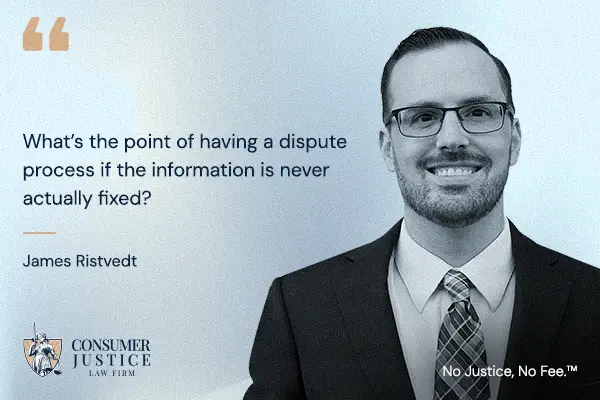
“What’s the point of having a dispute process if the information is never actually fixed? The jury’s verdict sends a clear message to companies in the industry that consumers shouldn’t have to spend years of their lives fighting to keep inaccurate information off their credit reports.” - James Ristvedt, Managing Attorney & Trial Counsel
Why Accurate Data Matters More Than Ever
The for-profit data industry has always been a problem child in the consumer world, but as more and more data flows in endlessly streams, and more businesses attempt to harness this data for profit, the impact of errors has grown too. From consumer data on the move, to failed dispute systems, accurate data not only matters more than ever, it’s also not always easy to protect.
Consumer Information Moves Across Multiple Systems
Modern consumer data does not stay in one place. Information is routinely shared among credit bureaus, lenders, banks, debt collectors, background screening companies, landlords, and countless third-party service providers. As data moves across these interconnected systems, a single mistake can spread quickly and affect multiple aspects of your life.
This reality makes accuracy more important than ever. An error may begin with one company, but the consequences can follow you across credit applications, housing decisions, employment opportunities, insurance pricing, and other important transactions. As businesses rely increasingly on automated data sharing and decision-making, you often have little visibility into where mistakes originated or how widely they have been distributed.
A Correction Is Not Enough if Errors Return
Removing inaccurate information should be the solution, but it is increasingly like pulling weeds, but leaving the root. It may take some time to realize the problem remains, but eventually, the errors resurface. So, for many consumers dealing with credit report errors, the real challenge begins when information that was previously corrected reappears months or even years later.
The allegations in Ms. Robinson’s case highlight this concern. According to the evidence presented at trial, inaccurate accounts were removed multiple times, only to return again. When consumers are forced to dispute the same information repeatedly, the burden shifts away from the companies responsible for maintaining accurate records and onto the individuals harmed by the errors.
A dispute process has limited value if corrections aren’t lasting. Meaningful compliance requires not only identifying mistakes, but also implementing procedures that prevent those mistakes from resurfacing.
Accountability Remains a Core Goal of the FCRA
The Fair Credit Reporting Act exists because accurate information is essential to fair economic opportunity. The law places responsibilities on credit reporting agencies, data furnishers, and other companies that collect, share, or use consumer information.
Cases like this one serve as a reminder that accountability remains a central goal of the FCRA. When companies fail to maintain reasonable procedures or adequately investigate disputed information, consumers can face significant and long-lasting consequences. Jury verdicts and other enforcement actions help reinforce the principle that accuracy is not optional. Companies that profit from consumer data must also take responsibility for ensuring that data is correct.
For consumers, the message is simple: credit reporting errors should not be ignored, and repeated inaccuracies should not have to become a permanent part of someone’s financial life. When companies violate your rights under the FCRA, they need to fix them.
Consumer Justice Law Firm at the CRLC in Atlanta
This year, as in prior years, Consumer Justice Law Firm was proud to serve as the Lead Sponsor of the Consumer Rights Litigation Conference (CRLC) in Atlanta, one of the nation’s premier gatherings of consumer protection attorneys.
The CLRC is organized by the National Association of Consumer Advocates (NACA) and the National Consumer Law Center (NCLC), two leading organizations dedicated to protecting consumers and advancing access to justice.
Our firm’s connection to NACA extends well beyond conference attendance. Every attorney at Consumer Justice Law Firm is a NACA member, reflecting our shared commitment to consumer advocacy and continuing legal education. We are also proud that two of our partners serve on NACA’s national board, helping support the organization’s mission and the broader consumer rights movement.
Connecting With Consumer Advocates Nationwide
With approximately 900 attorneys and advocates from across the country in attendance, the conference provided an invaluable opportunity to connect with professionals dedicated to protecting consumers and enforcing some of the most important consumer protection laws in the United States.
It was a privilege to meet so many passionate advocates, exchange ideas, and build relationships with attorneys working on behalf of consumers in communities nationwide. Events like the CRLC help strengthen the consumer rights movement by bringing together professionals who share a common goal: holding companies accountable when they violate consumers’ legal rights.
Discussing Emerging Consumer Protection Issues
The issues discussed throughout the conference closely mirror the work our firm performs every day. Many conversations focused on the growing challenges consumers face when inaccurate personal information is used to make decisions about credit, employment, housing, banking, and other important opportunities.
As consumer protection attorneys, our practice is heavily focused on consumer reporting issues under the Fair Credit Reporting Act (FCRA), helping individuals harmed by inaccurate credit reports, background checks, tenant screening reports, and insurance reports, and other consumer reports. We also represent victims of identity theft and unauthorized transactions under laws such as the Electronic Fund Transfer Act (EFTA), Fair Credit Billing Act (FCBA), the FCRA, and related consumer protection statutes. In addition, we advocate for consumers facing unlawful debt collection practices, including harassment and other violations of the Fair Debt Collection Practices Act (FDCPA).
The conference provided an opportunity to discuss emerging trends, recent case developments, and evolving challenges facing consumers in an increasingly data-driven economy.
Supporting the Consumer Rights Community
Our sponsorship of the CRLC reflects our continued commitment to the broader consumer rights community. Consumer protection laws are only as effective as the attorneys, advocates, and organizations willing to enforce them. By supporting conferences like the CRLC, we help foster collaboration, education, and the exchange of ideas that ultimately benefit consumers nationwide.
Whether the issue involves recurring credit reporting errors, identity theft, unauthorized electronic fund transfers, credit card fraud, or abusive debt collection practices, the mission remains the same: ensuring that consumers have meaningful remedies when businesses fail to follow the law. We were honored to support this year’s conference and grateful for the opportunity to meet so many dedicated consumer advocates from across the country.
Frequently Asked Questions
Credit reporting errors can affect loan approvals, housing opportunities, insurance rates, employment opportunities, and access to credit.
Yes. In some cases, previously deleted information can reappear if data furnishers continue reporting inaccurate information or correction processes fail.
Yes. The FCRA protects consumers of all ages and requires reasonable procedures to ensure maximum possible accuracy in consumer reports.
Maintain records of disputes, credit reports, correspondence, and any resulting harm. Repeated inaccuracies may warrant legal review.
The National Association of Consumer Advocates (NACA) is a nationwide organization of attorneys and advocates dedicated to protecting consumer rights and promoting fair treatment in the marketplace.
If credit report errors impact you at any age or stage of life, get a FREE consultation. You pay $0 out of pocket. We only get paid when we win. No Justice, No Fee™